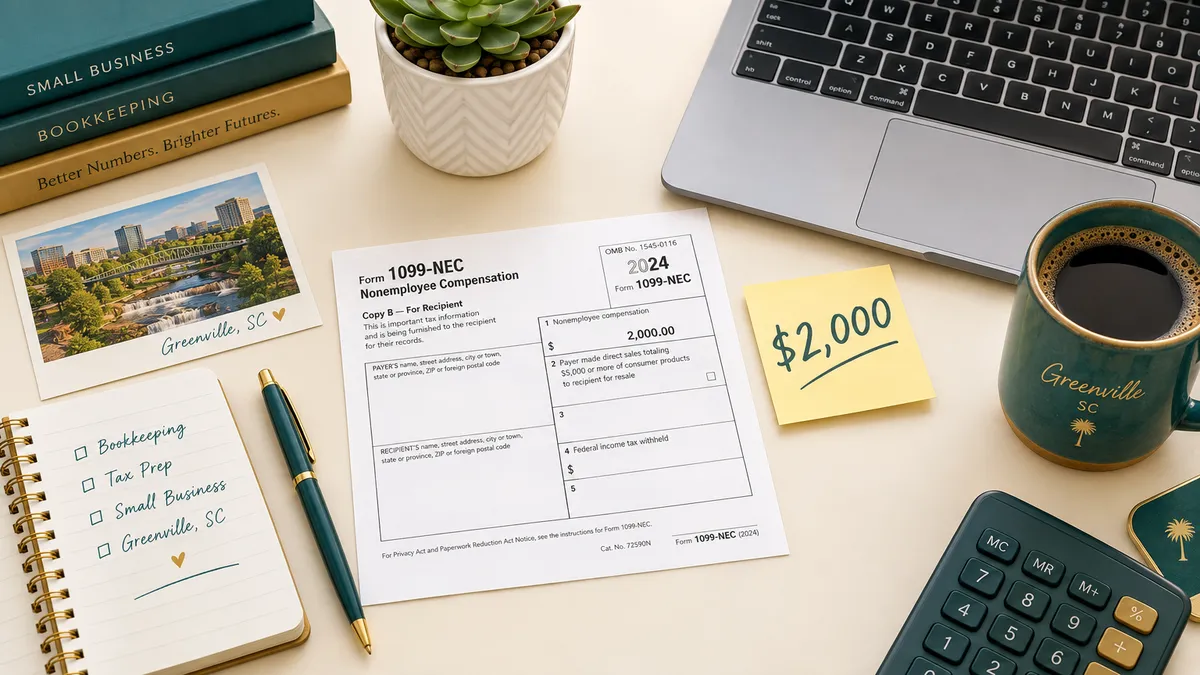
The 1099 Threshold Is Now $2,000: What SC Owners Need to Know
The 1099 Threshold Is Now $2,000: What SC Owners Need to Know
For 2026, the IRS reporting threshold for 1099-NEC and 1099-MISC payments jumped from $600 to $2,000 per payee. That means if you paid a contractor less than $2,000 this year, you generally do not need to file a 1099 for that person. But there are important details — and one habit you should keep no matter what the threshold is. Read on for a plain-English breakdown of what changed, what stays the same, and what to do right now.
What Is the 1099 Threshold, and Why Does It Matter?
A 1099-NEC (Nonemployee Compensation) is the tax form businesses use to report payments made to independent contractors and freelancers. The IRS uses it to make sure contractors report that income on their own tax returns.
The reporting threshold is the dollar amount above which you are required to file. If you pay a single contractor at or above that amount during the calendar year, you must send them a 1099-NEC and file a copy with the IRS. If you pay them less, you are generally not required to report it — though the contractor still owes taxes on every dollar they earn.
For many years the threshold sat at $600, which meant even a small one-time job could trigger paperwork. The new $2,000 level for 2026 reduces the number of forms many small businesses need to file — but it does not eliminate the need to track payments or collect information from your contractors.
What Changed for 2026: The One Big Beautiful Bill Act
The threshold increase is one of several small-business provisions in the One Big Beautiful Bill Act (OBBBA), signed into law in 2025. Here is a quick summary of the 1099 rules that apply to payments you make in tax year 2026:
| Form | 2025 Threshold | 2026 Threshold | What It Covers |
|---|---|---|---|
| 1099-NEC | $600 | $2,000 | Contractor / freelancer pay |
| 1099-MISC | $600 | $2,000 | Rents, prizes, other misc. payments |
| 1099-K | $600 | $20,000 & 200 transactions | Payment apps / processors (OBBBA cancelled the drop to $600) |
The $2,000 threshold applies to payments made during 2026. Starting in 2027, the threshold is indexed for inflation, so it may adjust slightly each year. Always verify the current-year figure before filing — your bookkeeper or CPA can confirm it in January.
Who Still Needs a 1099 in 2026?
The new threshold is a relief, but do not assume it eliminates all your 1099 obligations. Here is a practical checklist to work through before year-end:
- You paid a contractor $2,000 or more in 2026 → File a 1099-NEC. Deadline: February 1, 2027 (January 31, 2027 falls on a Sunday, so the deadline shifts to Monday).
- You paid a contractor less than $2,000 in 2026 → No 1099-NEC required for 2026 payments, but keep the record.
- You paid a corporation (Inc. or LLC taxed as a corporation) → Generally no 1099 required, but confirm with your CPA.
- You paid via credit card or a payment processor → The processor handles 1099-K reporting; you do not also file a 1099-NEC for those same payments.
- You are unsure whether a worker is an employee or a contractor → Stop and ask before you pay. Misclassification can mean back payroll taxes and penalties. When in doubt, talk with your CPA or tax preparer.
One rule that did not change: you still need the contractor's legal name, address, and taxpayer identification number (TIN) to file correctly. That is why the W-9 matters so much.
The W-9: Your Best Defense Against January Headaches
A W-9 is a simple IRS form that collects a contractor's name, business name, address, TIN, and entity type. When you have a completed W-9 on file, filling out the 1099 at year-end takes minutes. Without one, you may be scrambling to chase down contractors in January — or facing backup withholding rules.
Our advice: collect a W-9 from every new contractor before you pay them for the first time. It does not matter whether you think they will hit the $2,000 threshold. Circumstances change, extra work comes up, and it is far easier to collect the form upfront than to ask for it months later.
Keep signed W-9s on file for at least four years. Your bookkeeper can help you build a simple contractor tracking log so nothing slips through the cracks.
An Upstate Example: A Greer Landscaping Company
Consider an illustrative example: a Greer-based landscaping company that uses a mix of salaried employees and independent subcontractors for larger commercial jobs. In prior years, the owner filed 1099-NECs for every sub who earned $600 or more — often a dozen or more forms in January.
Under the 2026 rules, several of those subs who did only one or two smaller jobs during the year — earning $800 or $1,400 — would fall below the new $2,000 threshold. That means fewer forms to prepare and fewer opportunities for a missing TIN to cause a delay.
The owner still collects a W-9 from each subcontractor at the start of every season, so when a sub does cross $2,000, the paperwork is ready to go. That simple habit is what keeps January calm instead of chaotic.
What the New Threshold Does Not Change
A lower paperwork burden is welcome, but a few things stay exactly the same:
- Contractors owe tax on all their income, not just income above $2,000. The threshold only affects your filing obligation, not theirs.
- Your books still need to track every contractor payment for expense purposes, even if no 1099 is required.
- State rules may differ. South Carolina generally follows federal rules, but always confirm with your CPA for the current year.
- The deadline for filing 1099-NECs with the IRS and delivering copies to contractors is January 31 each year. For 2026 forms, that becomes February 1, 2027.
How Datamize Helps
- Contractor payment tracking: We keep a running record of every contractor payment throughout the year so you always know who is approaching the $2,000 threshold — no year-end surprises.
- W-9 collection support: We remind you when to request W-9s and maintain an organized contractor file so filing is straightforward in January.
- 1099 and W-2 year-end filing: 1099-NEC preparation and filing is included in our back-office services, so the January deadline does not fall on your plate.
- Bookkeeping and payroll under one roof: When your books and payroll are both with us, contractor payments and employee wages tie out cleanly — which your CPA will appreciate at tax time.
- Transparent pricing: Bookkeeping starts at $189/month; payroll starts at $129/month. Back-office and year-end filing services are quoted based on your volume and needs.
Frequently Asked Questions
Does the $2,000 threshold apply to payments I already made earlier in 2026?
Yes. The threshold applies to the total you paid a single contractor throughout all of tax year 2026 — January through December. Add up every payment to that person for the full year, and if the total reaches $2,000, a 1099-NEC is required.
What if I paid a contractor through PayPal, Venmo, or a similar app?
If the payment app or processor issues a 1099-K to the contractor for that transaction, you generally do not also file a 1099-NEC for the same payment. That said, tracking those payments in your books is still important. Ask your CPA how to handle the overlap for your specific situation.
I forgot to collect a W-9 from a contractor I already paid. What should I do?
Reach out to the contractor now and request the form. The sooner you collect it, the better — especially if their payments might cross $2,000 by December. If a contractor refuses to provide a W-9, you may be required to withhold a percentage of future payments. Your CPA or tax preparer can walk you through the next steps.
Do I need to file a 1099 for an LLC I paid for contract work?
It depends on how the LLC is taxed. Single-member LLCs taxed as sole proprietors generally do require a 1099; LLCs taxed as corporations generally do not. The W-9 form will tell you the correct entity classification — another reason to collect it before you pay.
Is the $2,000 threshold the same for all types of 1099 forms?
For 1099-NEC and 1099-MISC, the 2026 threshold is $2,000 per payee. The 1099-K threshold — used by payment apps and processors — is separate: $20,000 and 200 transactions for 2026. Different forms have different rules, so when in doubt, check with your CPA or tax preparer for the form that applies to your situation.
Ready to get your contractor records organized before year-end? Book your free 30-minute discovery call and let's make sure your books are 1099-ready before January arrives.
This article is for general educational purposes and isn't tax or legal advice. Tax rules change and every business is different, so talk with your CPA or tax preparer before making decisions. Datamize Business Services provides bookkeeping and payroll services and works alongside your tax professional.
Datamize Business Services is a Greenville, SC bookkeeping and payroll firm led by NACPB-certified bookkeeper Tomeka Capps, serving small businesses across the Upstate.
